By Warwick, Lonely Kids Club (Sydney, Australia). Republished on theSAA.com with permission. Visit Lonely Kids Club for more from Warwick and the team.
If you've just found someone selling your artwork, start by saving the listing and finding your original. I lost a fair bit of time filling out forms before I had everything in one place. These are the two things I wish I'd had open from the start.
- Evidence checklist (PDF). A one-page list of what to save and what to have ready before you report a listing.
- Copied listings tracker (XLSX). Keep the listing URLs, screenshots, complaint references and outcomes together. It opens in Excel and can be imported into Google Sheets.
Start with one listing
- Save the direct URL and take a dated screenshot showing the seller and the part of the listing you're reporting. Keep a copy somewhere you can still get to if the page disappears.
- Find the original and check whose rights are involved. If it's an artist's work and you're helping them, send them the evidence or get their permission to report on their behalf.
- Use the marketplace's official reporting form. Save the complaint reference, then check the original listing URL again and record what you see.
What worked for us on Temu
In January 2026 we estimated that there were around 1,000 listings for copies of our products. That included different sellers listing the same designs. It's an estimate of what we found, and we didn't have a verified count of removals.
Many sellers had also put our registered Lonely Kids Club name in the listing titles. We grouped listings that used the same mark into smaller batches and kept the URLs and screenshots ready outside the form. Some of those reports got removal confirmations the following day. Others took longer. We also spoke about it publicly around the same time, so I can't tell you what effect that had.
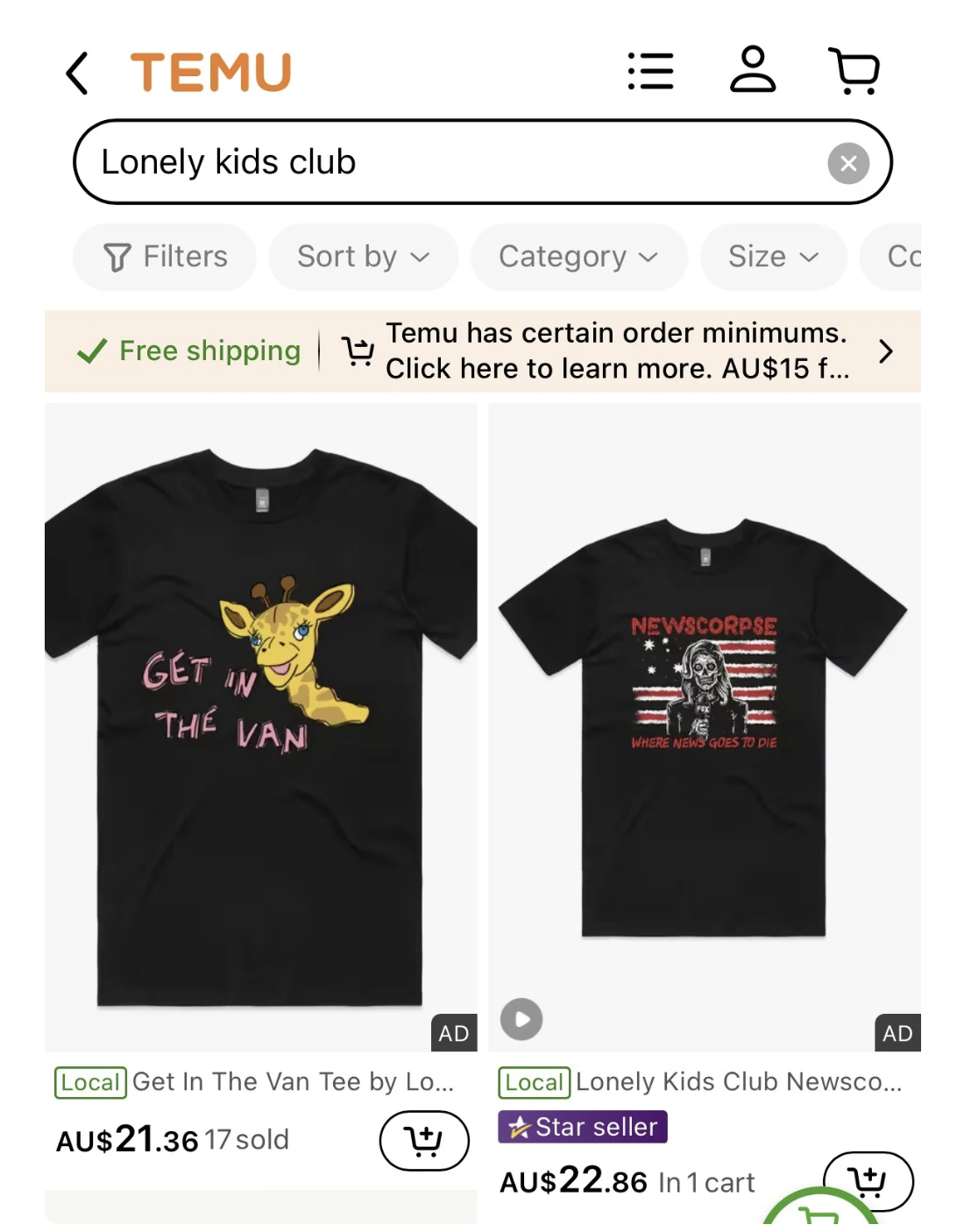
If all you can see is copied artwork, look at the copyright reporting route. Use a trade mark claim only where you have the relevant rights and evidence that the listing uses the mark. IP Australia's marketplace reporting guide and Temu's intellectual property policy explain the reporting options.
Our registered trademark let us get listings removed in bulk
This was the thing that made the biggest difference for us, so I'm putting it first.
Lonely Kids Club was already a registered trademark. A lot of the copied listings were also using the Lonely Kids Club name, which gave us something we could report across multiple products at once.
When people scrape your website to make these listings, they often keep your brand name in there too. That was happening with ours. The name gives the copies a way to show up when people search for your brand, so there's an obvious SEO and visibility benefit for the seller. In our case, it also made the listings easier to get removed.
I'd been spending ages trying to report the copied artworks individually. Once I focused on the unauthorised use of our registered name, I could group listings together and report them in bulk under the same trademark. The reports started moving much faster.
If you have a registered trademark and the copied listings are using it, get your registration certificate ready and take screenshots showing exactly where your name appears. Include the URLs for each listing you're reporting. The use of that same name across lots of listings was what made this so useful for us.
If you haven't trademarked your brand name, I think it's worth looking into. I was very glad we'd already done it. You can apply to register a trademark through IP Australia. Their guide covers checking the name and choosing the goods or services you want it to cover.
Having a business name or a website address doesn't mean you have a registered trademark. They're separate registrations. And getting a trademark registered takes time: IP Australia says at least seven months. You can start reporting copied artwork while that's being sorted out.
Copyright is a separate right. In Australia, protection for original artwork is generally automatic once the work is recorded or made, with no registration needed. Creative Workplaces explains it here. If someone has copied your artwork without using your brand name, that's the route to look at. Our trademark reports worked for the listings using our registered name; they weren't a blanket claim over every design.
Get your information ready before opening the form
I tried emailing Temu directly several times and never got a reply. What eventually worked for me was submitting reports through the Temu intellectual property reporting portal.
Before opening it, put the information you need in a separate document. This saved me having to write everything again whenever the form failed.
For the first batch, I'd get these together:
- The direct link to each copied listing, its seller name and a screenshot. Make sure any use of your brand name is visible.
- A link to your original product or artwork, plus evidence of when it was published. Original files and dated posts can help explain what's yours.
- Your trademark certificate and registration number if you're reporting use of a registered mark.
- A short explanation of what has been copied or how your name is being used, ready to paste across.
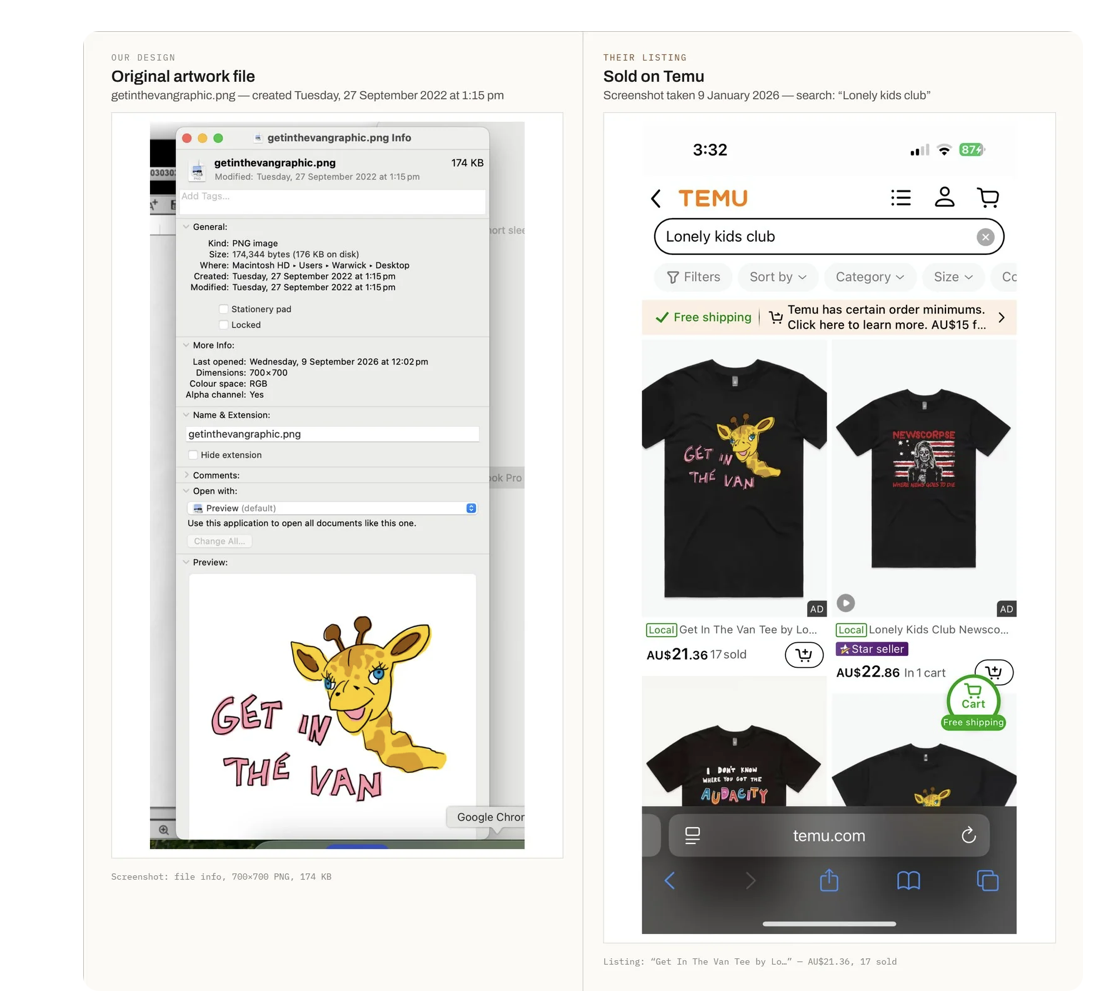
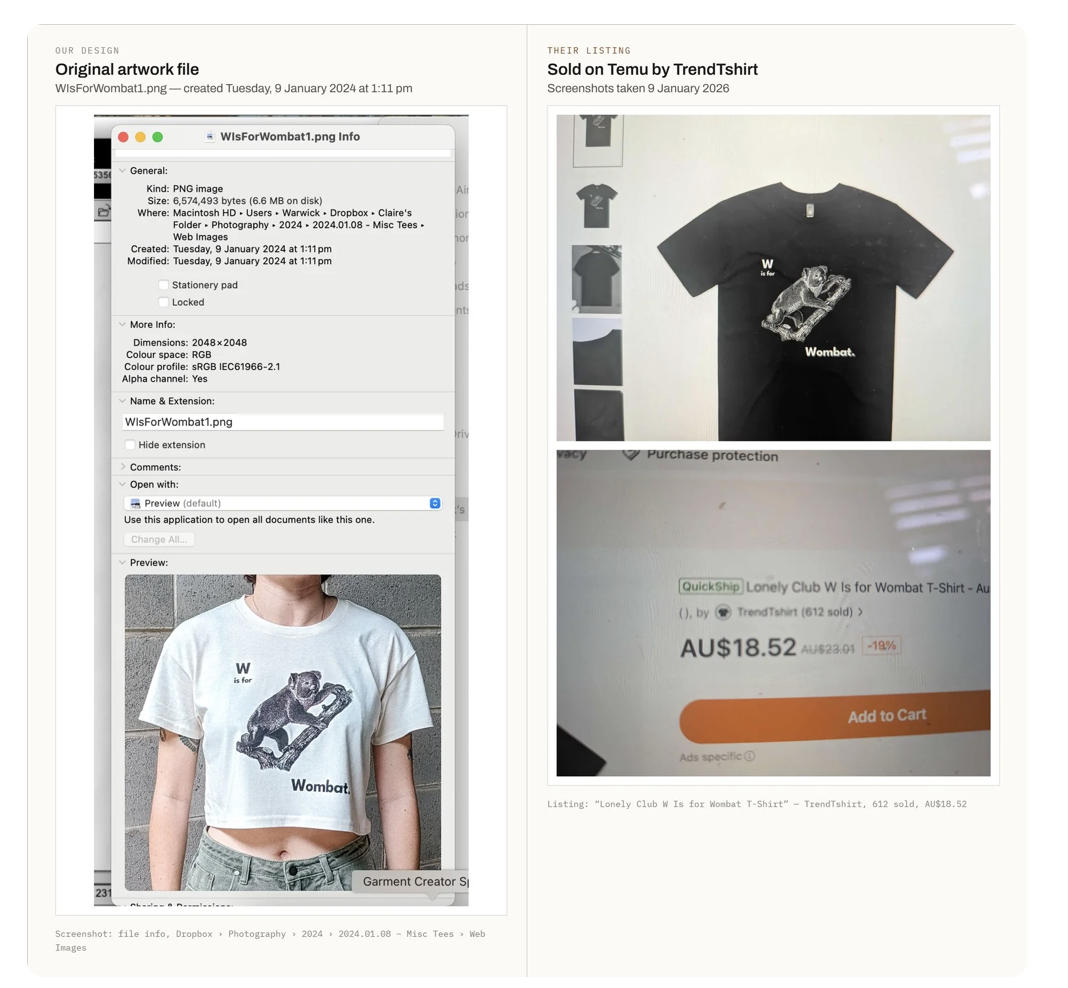
This is roughly what a prepared pair looked like for us. The original file with its creation date on one side, the live listing with the seller name, price and sold count on the other.
If you work with other artists, check who owns the relevant rights. The person submitting the formal report needs to be the rights owner or have permission to act for them. That's part of Temu's reporting requirements, along with your contact details and the declarations in the form.
You can start with one design or a small group of listings using your name. You don't need to finish finding every copy before sending the first report.
What helped when the Temu report form kept failing
The reporting form kept closing or resetting while I was using it. Sometimes I'd be close to submitting and lose what I'd done. The first few times, I thought I was doing something wrong.
I tried different browsers and devices and kept getting the same behaviour. Switching away from the form could make it disappear. I can't tell you what caused it, but keeping it visible on screen became part of how I got reports through.
I opened the portal in an incognito browser window, signed in, and kept my prepared document open alongside it. Then I copied the information across as quickly as I could, with the actual form still visible.
Leaving the tab open in the background wasn't enough in my case. I had to be able to see the form while I was doing the report. A separate window beside it helped.
I also kept each submission manageable. Using the trademark meant I could report multiple listings together, but trying to cram everything into one enormous report was unreliable. Several smaller batches worked better.
At the time, the form would let me enter loads of URLs but only upload five supporting images. That was particularly annoying when I was trying to show lots of different copied artworks. Check the limits it gives you now, and keep each batch small enough that the evidence clearly covers what you're reporting.
Hopefully the form behaves better for you. If it's doing the same thing, that setup is worth trying before you waste another afternoon on it.
Keep the explanation in your report simple
For a trademark report, explain which registered name is yours, where it appears in the copied listings and which products you want removed. You can adapt something like this for the description field:
I'm reporting these listings for unauthorised use of the registered trademark [brand name], registration number [number], registered in [country] for [relevant goods or services]. I am [the registered owner / authorised to act for the owner]. The listings use the mark in [the title, description or images] to sell [products]. I've attached the registration certificate and screenshots showing this, with the listing URLs below. Please remove the infringing listings.
Change it to match your situation and fill in the rest of the portal properly, including its declarations. For a copyright report, explain which original artwork is being copied and provide the evidence for that work.
Keep track of what actually gets removed
Save the complaint number and confirmation email against the URLs you submitted. A simple spreadsheet or document is enough. You want to be able to see what you've reported, what needs more information and what has come down.
Some of my January reports got removal confirmations the following day. Others took longer. After all the failed attempts, actually getting those emails was such a relief.
When a report is marked as dealt with, check the links yourself. If a copy turns up again, save the new URL and report it, keeping the earlier complaint details handy. A new listing can need a new report even if you've already dealt with that design.
If a report comes back asking for more information, read what's missing and add it to the document you're working from. That way you've got it ready for the next batch too.
Get a hand with it if you can
Kirsty McIntyre, one of our artists, helped flag copied LKC work and get listings taken down. Having someone else looking made a difference when there was so much to go through.
Even if someone just helps collect links and screenshots, that takes some of the work off you. If you're helping another artist, send them the actual listing link with the screenshot so they can use it in a report.
I also made a fuss about it on our socials. I can't tell you how much that affected the removals because I was submitting reports at the same time. I'd still get the formal complaints underway rather than wait for someone to notice a post.
We also added new security rules to our website after this. We still keep an eye out for copied listings.
Most of ours have stayed down
By the end of January, I was emailing Bridget's team saying I thought our stuff was all gone. They'd checked as well and couldn't find it either. There have been occasional copies since, but it's a much smaller problem now.
A few months later, Temu's marketing team started emailing us asking LKC to join their influencer program. They followed up several times, offering cash incentives of up to A$3,000 per round. After all the unanswered emails about getting our work removed, that was a fairly interesting email to receive.
I wish I'd known about the trademark approach and the form workaround at the start. It still took hours, but once I had a way to get reports through and started seeing listings disappear, it felt a lot more manageable.
If you've just found your work on there, save a few links and the evidence for those listings, then work on getting that first report submitted. You can come back to the rest. I hope this saves you some of the stuffing around I went through.
This article was originally written by Warwick of Lonely Kids Club and is republished here with his permission.
A note for UK readers: Warwick's links point to Australian guidance. In the UK, copyright in original artwork is also automatic, and trade marks are registered with the Intellectual Property Office. See the government's guides to protecting IP rights on e-commerce stores and registering a trade mark.